Can hidden data survive image compression?
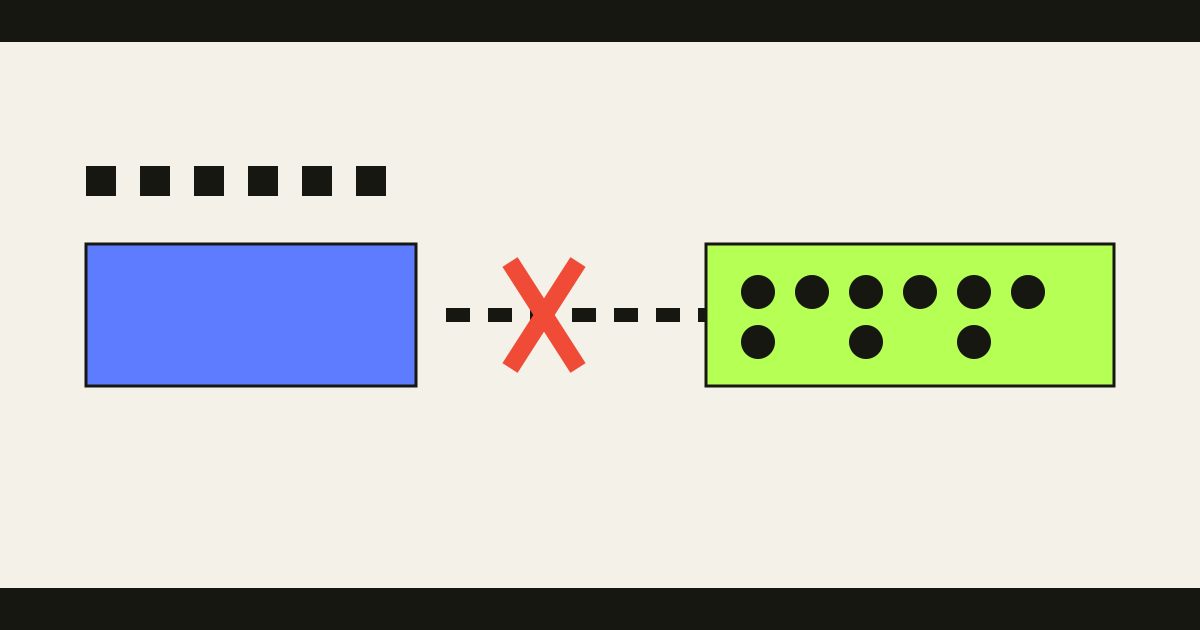
Our Website Inside an Image tool can hide a working page inside PNG pixels. Upload the same image to a platform that recompresses it, and the picture may come back looking unchanged while the website is dead.
The tempting fix is repetition. Store every bit three times, let the decoder vote, and survive a few mistakes.
That works only while the decoder can still find the three copies.
A crop can move every coordinate. A resize can replace the pixel grid. JPEG can damage bits in clusters rather than as isolated accidents. Before adding redundancy, we need to understand what kind of channel the image will pass through.
Image Compression Microscope
The picture can survive while the payload dies
Each square is one least-significant bit written before compression and read from the same channel after decoding. A crossed square changed.
8 × 8 transform blocks → quantization → entropy coding
The block view reproduces the transform and a conventional luminance table. It does not expose this browser encoder's private tables or chroma decisions.
8 × 8 luma samples
Transform coefficients
After quantization
61/64 coefficients became zero at quality 72.
The microscope shows the simplest failure. It writes known bits into exact red-green-blue (RGB) positions, sends the image through a real browser codec, and reads those positions again. The picture and the payload are judged by different standards: visual similarity for one, exact recovery for the other.
The current tool assumes the image is storage
The existing encoder writes its payload into those color samples in a fixed order:
pixel 0 red   → payload bit 0
pixel 0 green → payload bit 1
pixel 0 blue  → payload bit 2
pixel 1 red   → payload bit 3
...This works because the generated PNG preserves two things: the channel values and their positions. The decoder visits the same samples in the same order and recovers the same least-significant bits.
Lossy compression breaks the values. Cropping and resizing break the positions. A Cyclic Redundancy Check (CRC) can tell us that the final payload is wrong, but it cannot repair the bytes or tell us where the message moved.
The protocol is not poorly designed. It is well designed for an unchanged, lossless carrier. A hostile image pipeline is a different environment, so it needs a different representation.
Put the message in something the codec tries to preserve
JPEG does not store exact spatial pixels. It stores quantized frequency information and reconstructs the pixels later. The least significant bit of one channel is therefore a terrible place to demand stability: it sits exactly where small reconstruction errors are allowed.
A more robust design can move the signal into relationships that are more likely to survive. For example, it can adjust the magnitude or ordering of selected Discrete Cosine Transform (DCT) coefficients, then decode the relationship after recompression instead of looking for one exact RGB bit.
This changes the failure threshold. A stronger coefficient change is harder for JPEG to erase, but it can also become visible or statistically detectable. A weaker change hides better but disappears under heavier compression.
The classic spread-spectrum watermarking work by Cox, Kilian, Leighton, and Shamoon placed a low-amplitude signal in perceptually significant spectral components for this reason. Their 1997 paper also exposes a limit that becomes important later: when geometry changes, the detector first needs to register the transformed image.
Watermarking and steganography do not optimize for exactly the same goal. A watermark may only need to recover a small identifier. A hidden channel may need more capacity while also concealing that a message exists. The techniques overlap, but robustness always charges a price somewhere else.
Redundancy helps only after the errors have a shape
Once the signal lives in a representation that sometimes survives, redundancy can turn some remaining damage into a recoverable message.
Repetition provides several observations of one symbol. Interleaving separates neighboring payload symbols so that one damaged image block does not destroy one complete codeword. An error-correcting code then uses the surviving structure to repair a bounded number of missing or changed symbols. Finally, a checksum or cryptographic authenticator tests the recovered message.
These are different jobs. A CRC detects corruption but does not correct it. Error correction can rebuild damaged data but does not prove who created it. Interleaving spreads a burst but does not make the underlying signal stronger.
The order follows the failure: first choose a signal the channel often preserves, then spread correlated damage, then correct what remains, then validate the result.
Recent work on robust steganography combines embedding-region selection with adaptive error correction because redundancy consumes capacity and can make a pattern easier to detect. Duan and colleagues demonstrate one such balance in their 2023 work . The method is evidence for its evaluated JPEG conditions, not a recipe that automatically survives every platform.
A crop creates a location problem, not a bit-error problem
Now repeat each payload bit eight times and crop ten pixels from the left.
The copies may still exist, but the decoder starts reading them at the wrong addresses. Group boundaries shift. What looks like heavy corruption to an error-correcting code may actually be a perfectly intact signal with a broken coordinate system.
The decoder therefore needs synchronization before correction. It can search for repeated pilot patterns, align against stable image features, tile the payload across regions, or estimate scale, translation, rotation, and crop before reading the message.
Each choice creates another trade. Frequent anchors are easier to find but consume capacity and may reveal the channel. Sparse anchors can disappear. Feature-based alignment depends on the image. A broad geometric search costs computation and raises the chance of a false match.
Surviving JPEG does not imply surviving a crop. They are different failures and require different protections.
“Survives a platform” is an experiment, not a format claim
A platform does not merely choose JPEG. It may resize the upload, convert color, remove metadata, select an encoder and quality policy, generate several derivatives, or change that pipeline later.
The only useful robustness claim names the actual path and test conditions. A defensible experiment needs several kinds of carrier images, payload sizes, and transformations. It should measure the raw bit error before correction, successful packet recovery after correction, visible distortion, false detections on clean images, statistical detectability, and the capacity left after synchronization and redundancy.
One successful upload proves that one image survived one path once.
Research systems can perform well under defined conditions. A 2023 AAAI paper, “Robust Image Steganography: Hiding Messages in Frequency Coefficients” , evaluates an invertible-neural-network system across JPEG quality factors. Its model, payload, training distribution, and test protocol are part of the result. We cannot transfer its headline performance to a browser tool without reproducing those conditions.
The image stops being a box and becomes a channel
The PNG version treats selected pixels as memory cells. That is why it can carry a relatively large payload and recover it byte for byte—and why a tiny numerical change can ruin everything.
A robust version must treat the image as a noisy communication channel. The message becomes a signal distributed across features, located through synchronization, protected by redundancy, decoded within an error budget, and validated at the end.
It can survive more damage because it gives up something in return: capacity, invisibility, image fidelity, compute, or often several of them.
So robustness is not a stronger checksum added to the old trick. It is a new representation designed around the damage we expect the image to suffer.